Published by the Reality of Aid - Asia Pacific in 2021
See full article here: https://storymaps.arcgis.com/stories/68697a90d0664003a971e7bc8c53416e
The peoples of Manipur have long bore the brunt of the environmental and social impacts of transport projects pursued in their state. Since the construction of the Trans-Asian Highway and the Trans-Asian Railway post-1991—initiatives to develop highways and freight transport railways between Asia and Europe—aggressive development plans have subsequently been implemented, two of which are the questionable Imphal-Kangchup-Tamenglong road and the Imphal Ring road. [1]
On March 26, 2015, an agreement was signed between the Asian Development Bank (ADB) and the Government of India for the construction of these roads The bank provided USD 300 million loan while India provided counterpart financing of USD 125 million. [2]
To date, there are seven (7) ongoing ADB-funded roads and railways construction in India including projects in Imphal, all of which fall under the South Asia Subregional Economic Cooperation (SASEC) Regional Road Connectivity project. The SASEC is a partnership among Bhutan, India, Nepal, Maldives, Bangladesh, Sri Lanka, and Myanmar to boost international trade and investment by connecting their borders. Under the SASEC, 45 projects are dedicated to transport developments, amounting to a total of USD 12.35 billion in loans and grants. [3]
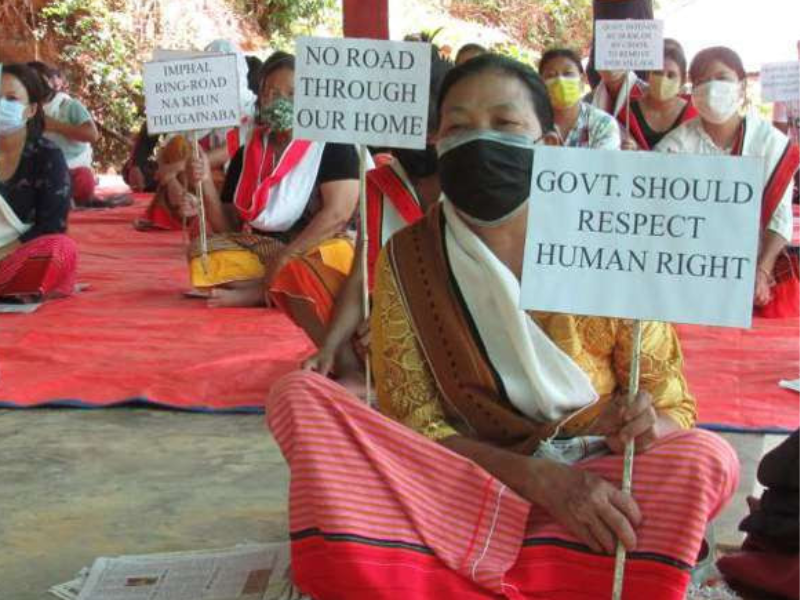
Despite protest actions and petitions raised by the affected sectors, Indian authorities remained rigid in pursuing the project without addressing the peoples’ concerns at hand.
To date, the Imphal Ring Road remains under negotiation between the project authorities and the affected communities. Despite this, the Government of India announced that the ongoing Imphal-Kangchup-Tamenglong Road will be completed by 2022.
The controversial transport development plan remains a roadblock in ensuring the communities’ environmental protection and the livelihood and safety of the Manipuri. Although the State Level Environment Impact Assessment Authority of the Government of Manipur granted the project an environmental clearance, the project has already severely damaged the natural resources in the area.
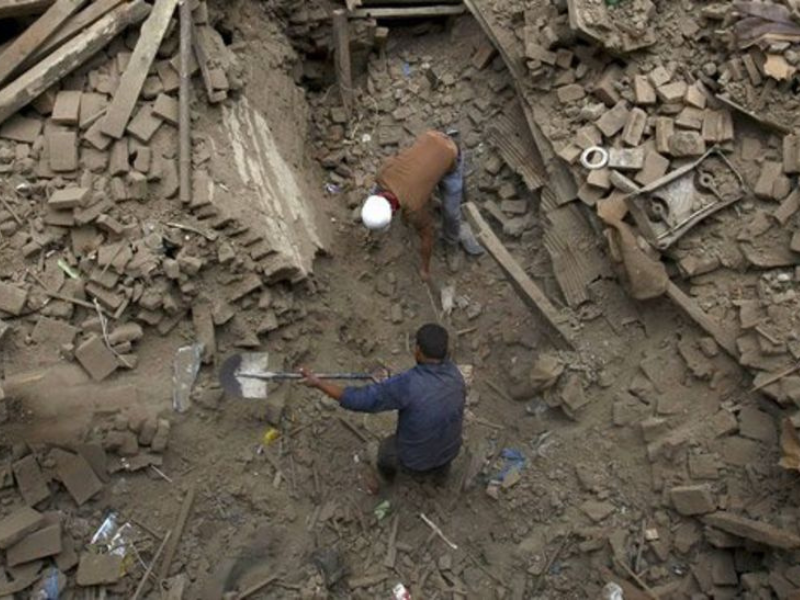
The debris from excavated earth and road-cut hills destroyed 64 acres of agricultural landas well as poisoned the aquatic species in the Duigathok and Atithok streams—the only fishing sources for the villagers.
The project authorities also did not file a forest clearance under the Forest Rights Act of 2006 under the Government of India’s Ministry of Tribal Affairs. Such law protects the rights of indigenous communities and forest dwellers to their natural resources. More than 100 hectares of forest land have already been destroyed in Bhalok, due to the road projects. Beyond the area, around ten (10) villages—including Langthabal, Langjing, Chingmeirong Cheirao Ching and Langol Hills, and adjoining forests—or more than 200 hectares, will be affected by these projects.
The destruction of forest lands will threaten the habitat of the migratory bird, Amur falcon, violating Section 50-51 of the Manipur Wildlife Protection Act of 1972. Despite these concerns, there are no initiatives taken by project authorities to request for the consent of affected villagers, nor apply for a forest clearance.
Not only did the projects violate laws on environmental preservation, but also Indigenous Peoples’ rights. There was an absence of inclusive processes, with no participatory impact assessment conducted, and with the lack of information, consultation and consent from affected communities. Despite the negative impacts of these projects, there was no proper community rehabilitation and resettlement provided for the Indigenous Peoples of Manipur.
Prior to the implementation of the project, even though the ADB prepared various documents such as the Rehabilitation and Resettlement Framework, Environment Impact Assessment, and Indigenous Peoples Action Plan; these were all violated once the project implementation commenced.
In fact, 70 houses in Phalong III were already demarcated to be demolished. More than 60 households in Langjing Achouba will also be uprooted. In nearby villages , around 500 families will be displaced. Meanwhile, in Phalong II, some villagers were forced to give up their land, for a compensation of only INR 10,000-30,000 or USD 130-400 per household—a measly amount compared to the estimated cost of USD 300 per month on housing alone in Imphal.
With these impacts, the Rongmei Tribe has lost their agricultural land and water source, affecting their income and food and water security. The main sources of living in the area include agriculture, fishing, and livestock farming. In fact, 52.8% of the 2.8 million population in Manipur (2011) engage in such livelihoods. [9]
Due to the road projects, reserve forest areas, water pipes, and traditional drainage systems that channel water to agricultural lands were destroyed. On top of that, the Government of Manipur failed to provide ample rehabilitation measures for the communities.
This illustrates how the government and the ADB prioritize infrastructure developments over social welfare to ensure the means of livelihood and the attainment of basic needs of the people. To worsen the situation, the total project expense of transport development in India amounting to almost USD 1.6 billion, are all loans. This hefty cost takes a toll on the people, with increasing taxes that push more Indians into poverty. According to 2011 data (DES Manipur), over 1 million citizens are impoverished in India.
ADB-funded projects in India have proven to disregard peoples’ rights and further degrade the environment. Consequently, affected communities and human rights and environmental defenders have asserted their rights in the face of corporate-led development. In the Reality of Aid CSO Observatorio Report , civil society organizations, such as the Phalong Village Authority and the Centre for Research and Advocacy - Manipur, forwarded calls addressed to ADB and other development actors to uphold their democratic rights in the planning and implementation of development projects. These include the following:
1. Reality of Aid. ADB’s Imphal Ring Road Plan and Controversy in Manipur. https://drive.google.com/file/d/1dxno8_HpXv67df1azcWEWBWxb61DV9Yd/view?usp=sharing
2. Yumnam, J. Implications of ADB Financed Kangchup - Tamenglong Road in Manipur. https://drive.google.com/file/d/1yNLbJN97QxocH8tMeIrRyQRugA6apo9f/view?usp=sharing
3. SASEC. Projects. https://www.sasec.asia/index.php?page=projects
4. Yumnam, J. ADB Road Projects and Concerns in Manipur. https://www.realityofaid.org/wp-content/uploads/2016/05/RC-1.pdf
5. Reality of Aid Full Report 2016. https://realityofaid.org/wp-content/uploads/2016/10/RoA-Full-Report-2016-ecopy.pdf
6. IFP Bureau. 2021, July 23. Stop construction of ring road without public participation: YFPHR. https://www.ifp.co.in/8614/stop-construction-of-ring-road-without-public-participation-yfphr
7. IFP Bureau. 2021, June 27. Proposed Ring Road: Villagers demand to keep Tharon unaffected. https://ifp.co.in/8130/proposed-ring-road-villagers-demand-to-keep-tharon-unaffected
8. IFP Bureau. 2020, December 17. Locals block roads in protest against ring-road construction in Manipur. https://ifp.co.in/4440/locals-block-roads-in-protest-against-ring-road-construction-in-manipur
9. Directorate of Economics and Statistics, Manipur. Economic Survey Manipur, 2020-21. http://desmanipur.gov.in/files/NewsFiles/15Feb2021011944Economic%20Survey%20Manipur,%202020-21.pdf