Published by the Philippine Collegian on September 11, 2020
See the published story here: https://phkule.org/article/61/the-widening-gap-between-students-and-education
There is a misconception that stories of struggle are passed on to give hope. When the pandemic struck, these same stories flooded the Internet: students climbing up mountains or crossing rivers to find signal, some selling various products, or others even asking for donations online. Some have even resorted to selling sensitive photos in anonymous chatting sites, so they can still go to school.
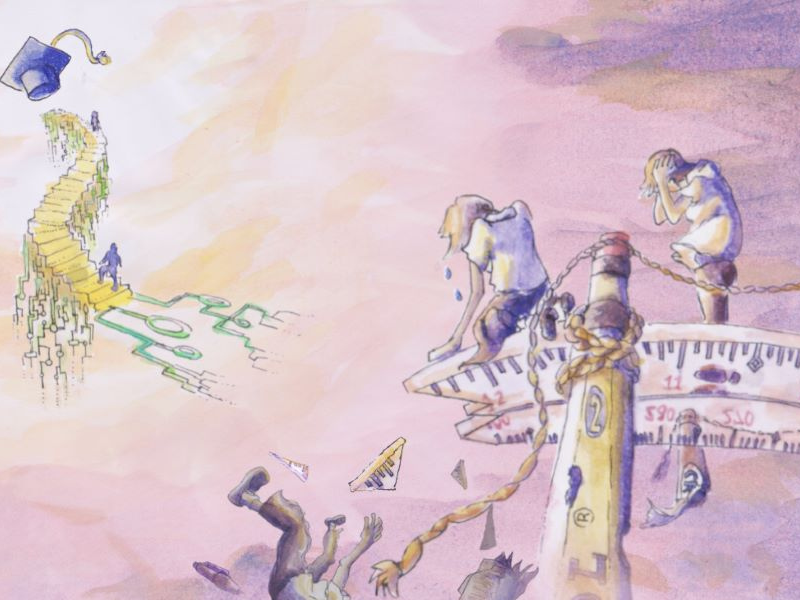
These are not tales of silver linings amidst hardship. These are exposés, symptomatic of systemic ills that have long plagued the education sector. Today, the right to education seems like a bridge too far as distance learning forces students to go through hell and high water just to meet its demands.
In the upcoming school year, the Department of Education (DepEd) introduced learning delivery modalities which use digital technology and self-learning modules. Because COVID-19 cases in the country have spiked up to more than 200,000—surpassing all countries in Southeast Asia—on-the-ground learning is not deemed an option in the near future.
However, the digital divide—lack of access to the Internet and other resources—worsened by financial loss, bars numerous students from continuing their education. The unpreparedness of the government to provide an inclusive mode of learning, and its inefficiency in addressing the health crisis, forces Filipinos to resort to sacrificial methods, further widening the gap between students and the education they deserve.
In 2017, 3.6 million youth are out-of-school, according to the Annual Poverty Indicator Survey. With the pandemic’s toll on the unemployment rate, this number is expected to increase. The Department of Labor and Employment (DOLE) reported that about 7.3 million Filipinos lost their jobs from the start of the lockdown, sinking families deeper into poverty.
DepEd calculated that around 4 million youth will not be enrolling for the next academic year. Shane*, 19, is one of those affected who had to stop school in order to work.
Just before the lockdown, he worked as a jeepney barker and a pedicab driver. But, with public transportation halted, he helped his mother sell cooked meals instead. Their earnings are still not enough for them to get by.
“Nakikita kong hirap si mama, minsan tulala—iniisip kung paano kami kakain kinabukasan,” he added. Shane decided to apply last June as an assistant vendor in a market stall in Montalban, Rizal, where he now earns P200 a day.
But working amidst a pandemic is taking its toll. Waking up at 4 a.m. and working until 8 p.m. have affected Shane’s health, causing him to contract a fever. He fears that this might be a symptom of the virus but worries more of when he can recover and continue earning again.
“Gusto ko talagang tumuloy [sa pag-aaral] pero hindi ko pa siya maisip ngayon dahil sa hirap,” he said. Shane longs for a better future for him and his four younger siblings, where education is no longer out of reach.
Although DepEd has reported that 23.6 million students have enrolled for the next school year, this is a 20 percent drop from last year. In fact, 365,000 students from private schools—of which 400 have closed—transferred to public institutions. With the lack of facilities and resources, the transfer of students will pose another problem for public schools. Prior to the pandemic, these schools, especially those understaffed, could barely accommodate all their students, burdening both the teachers and the learners.
The adjusted mode of learning is also placing a burden on parents who must work and take care of their family at the same time. Grace, 47, a single mother of five working as a housekeeper and freelance therapist, earns about P3,000 per week at a maximum. Even with two jobs, the money could barely cover her family’s bills and daily needs with the decrease of customers.
“Naubos na rin yung ipon sa haba ng lockdown kaya minsan alamang o chichirya na lang ang inuulam namin,” she said, sharing that she has lined up for two days for the Social Amelioration Program (SAP), since lockdown started, but to no avail.
Due to lack of income, she has no choice but to stop two of her children from going to school. They need to be enrolled in an alternative learning program, but Grace cannot afford to buy more school supplies for them nor have the time to closely assist them in their modular work, which DepEd encourages schools to adopt as an alternative to face-to-face classes. Her three other children are in elementary, with one of them receiving special assistance. Until now, their school has yet to develop plans on how to uphold special education services, other than shifting to modular learning.
“Hindi ko rin sila matututukan buong araw dahil sa trabaho,” Grace said, worried that the modules will not be enough without the help of a teacher. They can barely access the Internet given the lack of proper internet signal in the area, and there is only one phone for the children to share.
Last April 14, DepEd announced that the start of classes will be moved to October 5 due to blunders in the adjustment program as teachers had reported not receiving the promised self-learning modules. These issues expose how the education sector is not trained and prepared for emergencies and alternative modalities. Even before the health crisis, the lack of facilities in institutions, especially in public schools, have lowered the quality of learning, in addition to overworking of teachers and staff and insufficient funding, among others.
Many have called for an academic freeze as the number of students dropping out of school heightens, but this proposition tends to produce harmful effects in the long term. Massive unemployment of teachers and non-teaching personnel could result from the extended closure of schools and the lack of safety nets to subsidize their income amid the crisis. Lengthening school closures will also be futile if families like Grace’s will not be given assistance to cover their teaching needs and if schools fail to receive adequate support to adjust their learning modes.
The Centers for Disease Control and Prevention has reported that prolonged class suspension can also result in learning loss, especially for students with disabilities. Remote learning, on the other hand, is not an efficient option for effective learning and lesson retainment. Students who find safe spaces in school may continue to suffer unhealthy conditions at home.
An academic freeze also effectively erases the government’s accountability to urgently combat the COVID-19 crisis in an effort to reduce its spillover impacts on other sectors. The call for efficient action then resonates—to prioritize and quicken the pace in providing solutions to the health crisis and, at the same time, address the longstanding issues in education. The sector has, in fact, yet to fully adjust to the K-12 curriculum and fix long-existing problems, but now faces even greater challenges as the pandemic forces everyone to adjust to a new normal.
Medical solutions and programs must be implemented and strengthened—mass testing, increasing the compensation of frontliners, boosting the health budget, distributing assistance fairly to communities, and creating safety programs to protect workers. The sooner COVID cases die down, the quicker schools can reopen for learning on the ground.
Unless the state paves the path to ending the crisis and towards an inclusive, quality education, the gaping chasm between students and their goals will widen. Let the amplified calls for accountability and change reverberate and rise from the depths of people’s struggles, until every child is given the quality of life and education they deserve.
*not his real name, per his request