Published by the Union of Journalists of the Philippines - UP on June 26, 2021
Today marks the 15th year of Karen Empeño and Shirley Cadapan’s disappearance. The two UP Diliman students were seized by military abductors in Hagonoy, Bulacan on June 26, 2006. Empeño, a BA Sociology student, was researching on the plight of farmers in the area whereas Cadapan was a community organizer for the Alyansang Magbubukid ng Bulacan.
They were detained at Camp Tecson together with farmer Manuel Merino and were subjected to torture and harassment by the 7th Infantry Batallion. Jovito Palparan, known as Berdugo (“The Butcher '') for his brutal campaign against insurgency during the Arroyo administration, was charged guilty for kidnapping and illegal detention. Boastful of his reputation, he was proven a downright coward, hiding 3 years before his arrest in 2014.
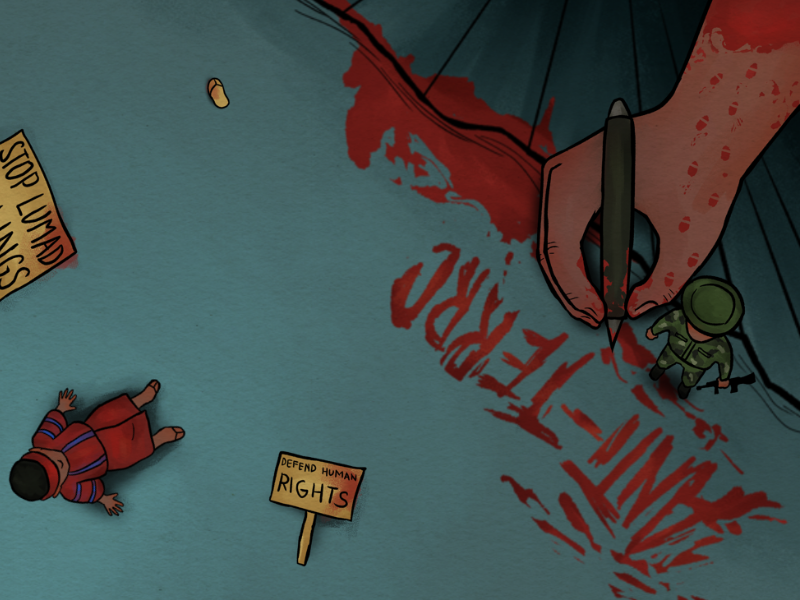
Though his conviction strikes a blow on impunity, justice remains slow and elusive as Empeño and Cadapan’s bodies remain unfound. The trail of disappearances and gross human rights violation lengthened, more so now in the Duterte regime.
Priding his iron fist and draconian measures, Duterte unleashed slaughter of rights through the murderous drug war, the attacks on human rights defenders and the media, and abusive orders and policies.
The struggle to fortify justice stands agonizing when the state tramples on right and freedom with impunity and violence. Veiled under false patriotism, the counterinsurgency tactic of each administration sinks to brutal crackdown, dragging lives to keep afloat their murderous control and power.
The reported number of disappearances from 1983 during the Martial Law to 2018 totaled to 2334 cases, Families of Victims of Involuntary Disappearance (FIND) recorded. Years of political repression and intensified clampdown on dissent branded a target on the backs of progressive groups and individuals.
Enforced disappearances became rampant under Ferdinand Marcos’s dictatorship—reaching 930 victims—as the military rounded up suspected insurgents. On top of that, about 9,000 were victims of human rights violations in the regime. But the tyrant’s ouster did not stop the heinous attacks and abductions.
In Corazon Aquino’s term, 825 desaparecidos were reported, even larger than Arroyo’s 346 under Oplan Bantay Laya. The administration backed itself with the US-maneuvered war tool, low intensity conflict (LIC) strategy, which limits the military front and utilizes propaganda, humanitarian aid, and paramilitary support.
This scheme—with resource, training, and intelligence from the imperialist US—retained the savage massacres, arrests, displacements, and attacks. Task Force Detainees of the Philippines (TFDP) tallied 1064 victims of killings, 1.2 million residents dislocated, 135 massacres, and 20,523 arrested or detained individuals.
Arroyo’s term similarly plagued the nation with human rights violations—with 1206 victims of extrajudicial executions, over 2000 illegal arrests (Karapatan), and the Ampatuan Massacre—aside from plunderous acts.
Though lesser than the others, Fidel Ramos, Joseph Estrada, and Benigno Aquino III’s terms documented 94, 63, and 31 cases of disappearance respectively—no better than the previously-mentioned administrations. The alarming trend proves the inaction of each president to bring justice to the victims and their kin and the negligence to protect the rights of their constituents. Now, 1165 desaparecidos are yet to be found, but the state acts as if they are forgotten.
Five years into Duterte’s term, the nation has become an inferno of abuses and attacks as the administration ratcheted up its anti-people approach and suppression of dissent. In the first two years alone, 45 cases of enforced disappearance were reported, 10 of which were found dead. Karapatan was able to record victims of politically-motivated disappearances, but more are yet to be tallied:
• 2016: Davis Mogul and Maki Bali, farmers from Sultan Kudarat and members of the Lumad group, Kesasabanay Dulangan Manobo (Keduma)
• 2017: Saypudin Rascal, a 13-year-old Maranao, was taken by military personnel in Lanao del Sur while their community was being bombed by an aerial strike.
• 2018: Joey Torres (Bayan Muna Central Luzon peasant organizer), Lora Manipis (National Democratic Front of the Philippines consultant) and husband Jeruel Domingo, and Res Sr. Hangadon
• 2019: Honey Mae Suazo, former secretary general of Karapatan, Deodicto Minosa of Anakpawis, and Argentina Madeja
• 2020: Jayson Calucin, John Ardi Cacao, and Elena Tijamo (Farmer’s Development Center)
In the drug war, more than 27,000 victims have been killed aside from the imprisoned and disappeared. The streets in the night were playgrounds of killing machines, the sound of guns ringing through the air. To worsen, the number of activists murdered by the state surpassed 300 and political prisoners increased to more than 629.
Such gruesome tales were sanctioned by Duterte himself, who ordered to shoot-to-kill human rights defenders, bomb indigenous schools, and harass women, among other malevolent remarks. Heightening the abhorrence, Duterte proved the double standard of justice in his term through temporary and permanent release of criminals and plunderers—of Gigi Reyes, Janet Lim Napoles, Gloria Arroyo, Jinggoy Estrada, Zaidy Ampatuan, Ramon Revilla, Jr., and Joseph Scott Pemberton, to name.
On the other hand, political prisoners do not receive an ounce of sympathy, not even when Reina Mae Nacino visited the wake of Baby River nor when Moreta and Selman Alegre grieved for Jesus Alegre. In an administration which favors the elite and hungers for power, injustice and impunity continue to victimize the masses. Despite numerous petitions from progressive groups to stop all forms of attack and violence, appeals fall on deaf ears while the state worsens its intimidation and silencing of the people they have sworn to protect.
In 2012, the Republic Act 10353 (Anti-Enforced or Involuntary Disappearance Act) was signed as the first in Asia to criminalize enforced and involuntary disappearances. Under the law, life imprisonment will be charged on individuals who committed, cooperated in, allowed, and “forced, instigated, encouraged, or induced” someone else to do the crime.
In a statement in 2013 by the families of desaparecidos, the signing was a step forward towards justice and holding perpetrators accountable. But the implementation of the law falls ineffective with roadblocks on budget and identifying cases.
For one, the concept of human rights and the nature of enforced disappearance remain unclear in the law, which could dismiss cases due to lack of probable cause. The tallying of reports also runs far slower in the Commission of Human Rights than FIND, added with the lack of funding to provide services for the victims’ families.
Though the provisions of the law could be helpful, it remains dead when poorly defined and executed, especially in a repressive administration. Now with the murderous Anti-Terrorism Act and the desperate attempt to abolish the UP-DND Accord, a nightmarish climate is set to heighten the rise of butchers of rights.
The Section 29 of the Anti-Terrorism Act specifically “allows the warrantless arrest and detention without charges of suspected terrorists for up to 24 days – as long as the law enforcement agent or military personnel are authorized in writing by the Anti-Terrorism Council.”
This provision clearly states its ability to be weaponized against progressives and to enforce disappearance and abduction. More than that, the government has made its move to delist 600 cases of disappearances in the UN Working Group on Enforced and Voluntary Disappearances.
The atmosphere of fear looms through regimes, but as long as anti-masses policies exist to trample upon human rights, the masses will not falter in their fight. The state’s crackdown on its constituents is an evident sign of its cowardice towards the power of the people to push back.
The disappeared will never be erased, but remembered through time until justice is found. Like Empeño and Cadapan, symbols of courage and militancy, Filipinos will hold true to their legacy of ousting a dictator and hold aggressors accountable. Lady justice may be blindfolded, but never blinded.
###
Sources:
Families of Victims of Involuntary Disappearance (FIND)
Human Rights Watch (HRW)
Asian Federation Against Involuntary Disappearances (AFAD)
Task Force Detainees of the Philippines (TFDP)
De Guzman, A. (n.d.). Right-wing Vigilantes, Human Rights Violations and LIC Under the Aquino Government. Manila Chronicle. PDF
https://www.bulatlat.com/2009/08/09/an-appraisal-cory-aquino-and-human-rights
/https://www.karapatan.org/Statement+of+Desaparecidos+on+the+Anti-Enforced+or+Involuntary+Disappearance+Act+of+2012+and+its+IRR
https://verafiles.org/articles/desaparecido-cases-rise-dutertes-war-drugs
###
Some other contributions to UJP-UP:
1. 2023 Minimum Wages Across the PH: https://www.facebook.com/100064615364652/posts/pfbid02FGf8FPJZu1nGGhjuLfndCbFTbbFXZ1qjveTGiXotcYfeYL9y47X1Dp3c159LkH4Jl/?mibextid=cr9u03
2. Justice for Sagay 9: https://www.facebook.com/100064615364652/posts/pfbid02zXm5cuyj2ZosF4n5ujq3ztSvrevZPdtNJ2Si8ad55YXMDCUvincnWvM4ah1eLRGUl/?mibextid=cr9u03
3. May 1 and 2, 2021 Crackdown on Journalists and Activists: https://www.facebook.com/635117696598408/posts/pfbid02ddJwitupGjBwFbG1LZhELgQHPzdUNvPkgin2EpJ6RLzEkx3U388YrQ2KZDkLQyrhl/?mibextid=cr9u03